Apologies for the tongue in cheek title but it seemed appropriate given the penchant for the dramatic displayed by Palladium Books in the pastcompany in question (see below for an explanation). Palladium Books has finally thrown in the towel on their Robotech RPG Tactics Kickstarter with less than 30 days left in their license for the property. After raising over $1.4 million USD in 2013 and claiming for years that the game was fine despite delays, they now claim that after producing only roughly half the rewards (more by model count, less by individual sculpt count) that they ran out of money years ago and can't produce the remaining rewards nor refund customers.
As a backer, I've covered this project and even come out with my VERMILION SQUADRON house rules for it (link here). I've avoided criticizing it too harshly here in the past as the project was by the barest definition "ongoing" but Palladium has officially abdicated their substantial remaining contractual obligations after 5 years (four of which had *ZERO* rewards fulfilled). The initial wave of miniatures were unfortuantely very poorly designed with upwards of 20 parts of a 40mm scale figure with seemingly unnecessary splits including 3 part heads and 4 part legs that somehow still result in a lack of real poseability. There was a little hope mid 2017 with the announcement
that a "project manager" was hired for the company and specifically for
the project but his biweekly updates soon turned into useless filler
that ignored the real issues of the campaign in favor of answering
questions no one asked as well as posting a single typo ridden minor
rules supplement using uncredited pilfered creative commons art.
It's long been speculated that the company used backer funds that were supposed to be reserved for the production of wave 2 to instead purchase most if not all of the thousands of retail copies of the game. Prior to the crowdfunding, Palladium was in dire financial straights after a years earlier embezzlement by an employee (which they named the "Crisis of Treachery" and which was the inspiration for this blog post title parody) and were frequently unable to reprint books from their catalog for years at a time. One of the stated goals of the crowdfunding in interviews was to allow Palladium to be on stable financial footing and they magically were able to suddenly reprint titles after the crowdfunding as well as finish their prior crowdfunded RPG books that were a year overdue. Now they claim that they also have no money yet they're sitting on thousands of retail boxes that they seemingly couldn't afford either. Their pricing breakdown for the production and development costs certainly do nothing to dissuade that theory either as the per unit cost to produce the boxes would put them at a loss if the funds only account for the backer copies they were supposed to pay for.
While Palladium is offering a trade program of sorts for your remaining credit, the relative values are increadibly skewed in their favor. The remaining outstanding Wave 2 rewards in the base pledge according to their add on math come to over $200 yet they're offering roughly $30 in trade for existing items. Additionally, backers must pay for shipping depite it being included in the original crowdfunding as well (and Palladium apparently having a reputation for charging exhorbitant shipping costs as well traditionally). To say that many backers are disappointed would be an understatement. After years of misleading backers, Palladium waited until just a few weeks before their license expired to finally come clean as to the supposed real state of the project and to offer a pittance of credit for product backers already have that they themselves would contractually be required to destroy in a few weeks. Other than cases of outright fraud, I can't think of a gaming related crowdfunding project that started out so promising and was mismanaged so badly. Palladium truly deserves the permanent hit to their already lackluster reputation that they'll inevitably get for how they've treated their most loyal customers since 2013.

TABLETOP MINIATURES HOBBY BLOG ABOUT SCIFI WARFARE WAGED FROM THE SAFETY AND COMFORT OF YOUR CHAIR!
Showing posts with label Vermilion Squadron. Show all posts
Showing posts with label Vermilion Squadron. Show all posts
Sunday, March 4, 2018


Wednesday, January 6, 2016
2015 and Beyond... Part I
I had initially planned on doing a detailed review of the year 2015 but something derailed my plans... netflix! I had gotten a membership to the service for Christmas and ,instead of working on the final hobby project of the year and the year in review post, I've been watching things like Knights of Sidonia and Jessica Jones! It's a bit late for a proper year in review but I'd still like to share a couple of some thoughts on 2015 and 2016 in a sort of State of the Blog address.
First, we'll start with 2015. While it didn't feel like a particularly productive year, I did mostly accomplish several projects that I set out to do. The first is my Farsight Tau ally army.

I actually completely finished this project around the summer but then ran into a bit of a snag as credible rumors started coming out about a new set of rules for the army. When they did a few short weeks later, I realized I'd probably want to add another model to my small group to make it a functional force with the new rules. I built, primed, and washed that final model (my Broadside conversion) but failed my will save vs Netflix and binged on some shows instead of finishing the model. I do hope though to get it done this month though.
The next project that I worked on this year was my set of house rules for the Robotech Tactics minis game that I dubbed "Vermilion Squadron".

I got in early on the game's kickstarter in large part because of a promised set of small model count skirmish rules. When half the rewards were finally released a year late (with the remaining half still pending and approaching three years late...grumble... grumble), the skirmish rules were unfortunately not included and got lost along the wayside. I decided to try and make a relatively quick set of house rules to retrofit back into the game that functionality. It wasn't as large in scope of a house rule product as my Heavy Gear houserules but I'm happy with the results.
The final main project that I worked on was two fleets for the newly released Halo Fleet Battles game. I initially thought that I'd do only a single fleet that was easily divisible in half for demos; after finishing that first fleet, I decided to just make a proper OpFor for the game.


With a few non-modelled options like Spartans and Zealots onboard ships, I'm at around 900-1000pts for each fleet with regard to what I can carry in my foam case. Not pictured above is the extra base of small UNSC frigates that replace the second large carrier for that faction.
Of course, not everything is rosy as I did have a pair of projects that I had planned to complete in 2015 that I didn't. I'll be discussing them along with some initial thoughts on 2016 in the next post that I'll hopefully put out today as well.
First, we'll start with 2015. While it didn't feel like a particularly productive year, I did mostly accomplish several projects that I set out to do. The first is my Farsight Tau ally army.

I actually completely finished this project around the summer but then ran into a bit of a snag as credible rumors started coming out about a new set of rules for the army. When they did a few short weeks later, I realized I'd probably want to add another model to my small group to make it a functional force with the new rules. I built, primed, and washed that final model (my Broadside conversion) but failed my will save vs Netflix and binged on some shows instead of finishing the model. I do hope though to get it done this month though.
The next project that I worked on this year was my set of house rules for the Robotech Tactics minis game that I dubbed "Vermilion Squadron".

I got in early on the game's kickstarter in large part because of a promised set of small model count skirmish rules. When half the rewards were finally released a year late (with the remaining half still pending and approaching three years late...grumble... grumble), the skirmish rules were unfortunately not included and got lost along the wayside. I decided to try and make a relatively quick set of house rules to retrofit back into the game that functionality. It wasn't as large in scope of a house rule product as my Heavy Gear houserules but I'm happy with the results.
The final main project that I worked on was two fleets for the newly released Halo Fleet Battles game. I initially thought that I'd do only a single fleet that was easily divisible in half for demos; after finishing that first fleet, I decided to just make a proper OpFor for the game.
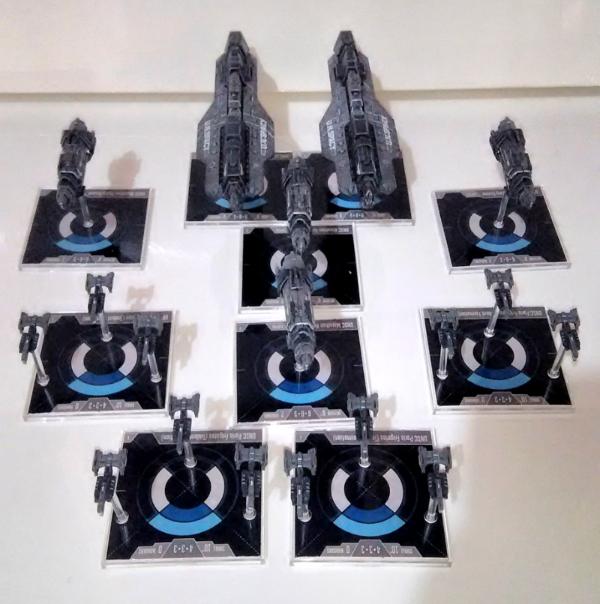
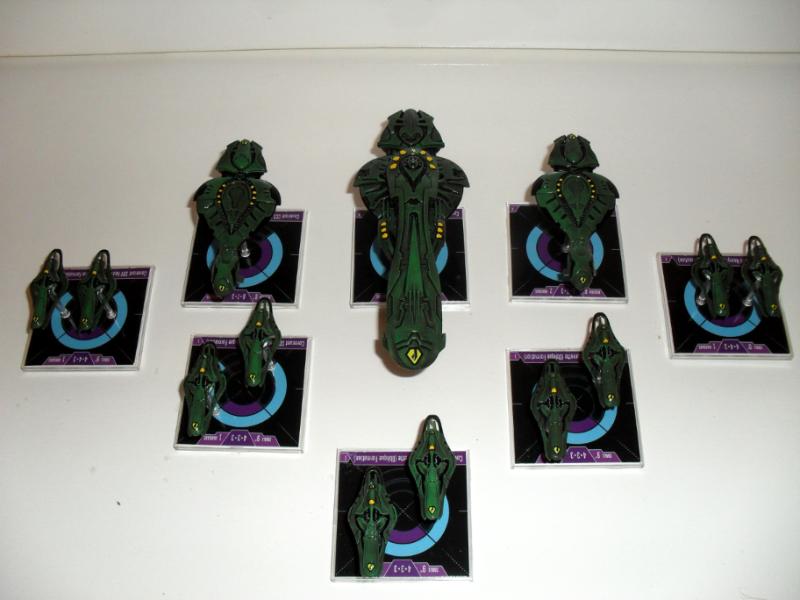
With a few non-modelled options like Spartans and Zealots onboard ships, I'm at around 900-1000pts for each fleet with regard to what I can carry in my foam case. Not pictured above is the extra base of small UNSC frigates that replace the second large carrier for that faction.
Of course, not everything is rosy as I did have a pair of projects that I had planned to complete in 2015 that I didn't. I'll be discussing them along with some initial thoughts on 2016 in the next post that I'll hopefully put out today as well.
Thursday, June 25, 2015
Vermilion Feedback and Sample Forces
It's been a few days which is probably enough for the relatively small amount of changes in my Vermilion Squadron skirmish house rules to sink in for any readers. I've gotten two questions and wanted to respond to the feedback. The first was from a reader on dakka who asked why I opted to go with model within a squadron activation instead of allowing any model to be activated in any order. My answer was threefold: backward compatibility, close formation, and ease of tracking. I found with my Heavy Gear Blitz house rules (the FLASH! link to the right) that if you change more than just a token amount that folks who are familiar with the system simply won't try it. It's unofficial so not worth the effort if it involves relearning what they're used to as opposed to just tweaking it a little. By keeping the model activation "nested" within the squadron first (you must resolve all activations within a squadron before moving to the next model in the next squadron), players have some familiarity from the main game but still get the utility of activating individual models. This is admittedly a very soft reason and I admit that keeping the squadron limitation was actually a late addition to the house rules.
edit: In the meantime, I have tweaked the rules above in response to feedback and another trial (but only solo) game so the activation rules are no longer as described above.
The other two reasons are in reality equally soft. It really isn't hard to remember which models have activated but it is a bit easier if you do it by squadron (I moved a valkyrie last turn so I'll have to move another this turn). In order to utilize the close formation rule, you pretty much have to activate by squadron as the models all fire simulataneously when using the rule. With my new reserve fire rule, you could theoretically get around that restriction but I wanted to minimize the counters on the tabletop since the main game doesn't use them.
The second bit of feedback was much broader in the form of a question about why the skirmish rules need to exist at all with the introductory scenario rules in the book. The introductory scenarios are very rigid without any structure to expanding beyond what is written. In the first scenario, one side gets 2x VF-1A (40pts) versus 6x Regults (35pts). There is no room for tweaking with the rules as written and the forces aren't even technically equal. They're perfectly adequate for learning the rules which is their primary purpose but not for playing a fuller game at a smaller points total. You could always just say "take whatever you want for the same points total" instead of using my Vermilion rules and that would be perfectly acceptable. I'd like to think that my house rules offer (in 40k terms) a "kill team" set of organized rules as opposed to just playing unbound at 200pts instead (which is what that alternate "take whatever" option would be akin to).
For instance, in the above scenario, a pair of players who picked up a copy of the rulebook at gencon for $10 as well as the two model packs above could either play:
2xVF-1A (40pts) + Long Range missiles (10pts) versus 6x Regults (35pts) + Veteran Warriors (10pts) + Grel (5pts)
Instead of just the two vanilla unequal forces in the intro scenario. My goal was to come up with some skirmish scale rules that would allow folks to pretty much pick up almost any box and be able to play a customizable full feeling game with it versus another. The only exception to this would be if someone bought only a "special" card only box like a Glaug Eldare or Mac II Monster box as specials need to be attached to a support card still due to their intended rarity in game. Another sample force straight from the anime unplayable in the main game:
Vermilion Squadron (2x VF-1A 40pts, 1x VF-1J 25pts, Ben 5pts, Max 10pts, Rick 10pts) 90pts
You could expand the above forces with the models that come in their boxes to add in a VF-1S with Roy Fokker for the UEDF and add a second squadron of another 2 artillery pods plus recon and recovery pods (along with veteran warriors) to bump up the skirmish game to the max 150pts.
Which brings me to the final point for this post which is why I set up a limit of 150pts. The first and foremost is that I intended these house rules to be at a specifically different model count than the normal game that starts at 300pts. At 150pts, you could still spam two dozen units on the zentraedi side using stock regults or infantry which is already stretching the goal of a "skirmish" game to the limits. Using the custom RPG character conversion rules, I could easily see the more expensive RPG character models going right up to the minimum 300pt main game limit without increasing the model count. That could be useful for players who want to enact combat scenarios from their RPG campaign with a bit less lethality than the normal game would have.
As always, thanks for reading and feel free to leave feedback in the comments.
edit: In the meantime, I have tweaked the rules above in response to feedback and another trial (but only solo) game so the activation rules are no longer as described above.
The other two reasons are in reality equally soft. It really isn't hard to remember which models have activated but it is a bit easier if you do it by squadron (I moved a valkyrie last turn so I'll have to move another this turn). In order to utilize the close formation rule, you pretty much have to activate by squadron as the models all fire simulataneously when using the rule. With my new reserve fire rule, you could theoretically get around that restriction but I wanted to minimize the counters on the tabletop since the main game doesn't use them.
The second bit of feedback was much broader in the form of a question about why the skirmish rules need to exist at all with the introductory scenario rules in the book. The introductory scenarios are very rigid without any structure to expanding beyond what is written. In the first scenario, one side gets 2x VF-1A (40pts) versus 6x Regults (35pts). There is no room for tweaking with the rules as written and the forces aren't even technically equal. They're perfectly adequate for learning the rules which is their primary purpose but not for playing a fuller game at a smaller points total. You could always just say "take whatever you want for the same points total" instead of using my Vermilion rules and that would be perfectly acceptable. I'd like to think that my house rules offer (in 40k terms) a "kill team" set of organized rules as opposed to just playing unbound at 200pts instead (which is what that alternate "take whatever" option would be akin to).
For instance, in the above scenario, a pair of players who picked up a copy of the rulebook at gencon for $10 as well as the two model packs above could either play:
2xVF-1A (40pts) + Long Range missiles (10pts) versus 6x Regults (35pts) + Veteran Warriors (10pts) + Grel (5pts)
Instead of just the two vanilla unequal forces in the intro scenario. My goal was to come up with some skirmish scale rules that would allow folks to pretty much pick up almost any box and be able to play a customizable full feeling game with it versus another. The only exception to this would be if someone bought only a "special" card only box like a Glaug Eldare or Mac II Monster box as specials need to be attached to a support card still due to their intended rarity in game. Another sample force straight from the anime unplayable in the main game:
Sweet Sixteen Attack
versus
Botoru Squadron (6x Regult 35pts, 1x Glaug 20pts, 2x Light Artillery Pods 25pts, Khyron 10pts) 90ptsYou could expand the above forces with the models that come in their boxes to add in a VF-1S with Roy Fokker for the UEDF and add a second squadron of another 2 artillery pods plus recon and recovery pods (along with veteran warriors) to bump up the skirmish game to the max 150pts.
Which brings me to the final point for this post which is why I set up a limit of 150pts. The first and foremost is that I intended these house rules to be at a specifically different model count than the normal game that starts at 300pts. At 150pts, you could still spam two dozen units on the zentraedi side using stock regults or infantry which is already stretching the goal of a "skirmish" game to the limits. Using the custom RPG character conversion rules, I could easily see the more expensive RPG character models going right up to the minimum 300pt main game limit without increasing the model count. That could be useful for players who want to enact combat scenarios from their RPG campaign with a bit less lethality than the normal game would have.
As always, thanks for reading and feel free to leave feedback in the comments.
Friday, June 19, 2015
Combat Changes


Part 3: COMBAT CHANGES
Unless specifically noted as changed below, use the rules as written in
the Robotech RPG Tactics rulebook. All house rules presented below are
100% unofficial fan creations and not endorsed by anyone except maybe
me. :)
Line of Sight (pg. 11-12): Replace references to the "center" of the torso with "any part" of the torso (or hull for non-humanoid models).
THE TURN
STEP 1: The Activation Step (pg. 14): Choose a single model in your army and activate that model. Complete the action phase steps with that model (movement, combat, resolution) before passing the activation to your opponent who activates a single model as well or passes the activation. When determining if a player can pass a model's activation, count the individual remaining models on the table instead of squadrons to determine if which player is outnumbered.
Stealing the Activation (pg. 14): If you have a model with the Leadership ability, roll a number of dice equal to the highest Leadership value in your force currently deployed on the table when attempting to steal or to prevent the stealing of the Activation instead of 3d6.
RANGED COMBAT
Attempt to Dodge (pg. 16): If you are hit by multiple simultaneous attacks like a missile volley or reserved attacks from a close formation (see below), you may attempt to dodge by rolling 1d6 for EACH missile or individual reserved attack instead of rolling one die for all of them. You MAY dodge missile attacks of any volley size. For instance, if you are hit by a volley of 6 missiles, spend a single command point to attempt to dodge and roll 6 dice using the normal rules to resolve the attack.
Close Formation (pg. 18): Because of the changes to activation above, it is now much more difficult to gain the close formation bonus. To make up for this, you may declare after moving a model that you are reserving its ranged attack instead of firing. Place some sort of marker next to that model. Any models from that same squadron that subsequently ends their movement in close formation range (2") with reserved fire model or close formation must EITHER reserve their attack also OR the player must simultaneously fire with all the reserved models in that close formation including the just moved model. If the original model with the reserved fire marker is destroyed prior to firing, simply move the marker to another model in that same close formation; if none are present, remove the marker. Any unused reserved fire markers should be removed from the table in the next command phase.
Anti-Missile (pg. 27): Roll 1d6 per incoming missile in a volley to see how many you shoot down instead of a single die. For example, if you are hit by a volley of 6 missiles, you roll 6 dice to see how many individual missiles you shoot down before moving on to the next step.
Thursday, June 18, 2015
Army Creation and Scenarios
Part 2: Army Creation and Scenarios
INTRODUCTORY SCENARIOS (pg. 73)
Ignore this section when using the Vermilion Squadron skirmish rules. While these scenarios may be helpful for learning the core rules, the skirmish rules presented here are intended to provide a more varied experience for smaller games.
BUILDING AN ARMY (pg. 75)
Factions: Please note that the "Life is Cheap" rule is still in effect in these skirmish house rules unlike in the official introductory scenarios.
Force Cards: Vermilion Squadron does NOT use Core cards. Ignore any references to them in the rules and replace "core card" with "primary support card" instead.
Support Cards: Choose one support card to create each squadron; this card is referred to as the primary support card. Subsequent support cards may either be used as primary cards to start their own squadron OR used as a secondary support card to add to an existing squadron. You may only add a single support card of the same type to each primary support card. For example, you could designate a Spartan Destroid support card as a primary thereby making a squadron and then add a Phalanx Destroid Support card as a secondary to the squadron (but not a valkyrie support option as it is a different type). Please note the additional minimum and maximum model and card count restrictions for game size listed below . Additionally, due to the smaller format of the Vermilion Squadron rules, you shoud add the option of a support card to the UEDF faction support card list that allows the taking of a single VF-1J for 25pts. The VF-1J has the same stats as the normal version included in a full size Veritech Squadron core card.
Special Cards: You may choose a SINGLE special card to add to one squadron in your army. This special card may be a RPG Character conversion if you and your opponent both agree to their use. You may use the official special characters as normal as they do not count toward that limit unless used on a special card mecha per the normal rules.
Minimum and Maximum Requirements: You must field a minimum of one support card per 50pts up to a maximum of two support cards per 50pts of your army (up to 150pts). Additionally, there is a minimum of 2 models in the army to a maximum of 24 for skirmish games.
STANDARD SCENARIOS (pg. 78-80)
DEMOLITION: Additional Rules: Always use the 25 MDC per card Bunker value for Vermilion Squadron skirmish games.
CONVOY DEFENSE:
Forces: The defender gets a single squadron of 1 Convoy Vehicle per 50pts or fraction thereof. For example, a 100pt game would have a single squadron of two convoy vehicles.
Additional Rules: Convoy Vehicle MDC: 4
COMMON SCENARIO SPECIAL RULES (pg. 80-83)
BATTLE GROUPS: Ignore this entry as it is intended for much larger games.
SKIRMISH GAMES: The Vermilion Squadron rules presented here on this blog replace this entry.
STRATEGIC DEPLOYMENT: You may only use this rule if you have more than 4 models per 50pts of your army as well as at least two squadrons. If you do not meet both of those criteria, you may not use this rule or any that depend on it (such as airborne assault). Instead deploy all your models on the table as outlined on the chosen individual mission's deployment subheading.
Max, Rick, and Ben... ATTACK!

UNOFFICIAL SKIRMISH RULES
Part 1: Introduction (below)
Part 1: Introduction
After discussing Robotech a bit more on various online forums, my interest in assembling some of the models that I received with my Kickstarter Wave 1 shipment was rekindled. While planning out how I would build my models, my old ideas about expanding on the skirmish scale rules for Palladium's new Robotech RPG Tactics game were reignited as well. For the TL;DR version, check out the paragraph below :) If I'm feeling particularly verbose, I write the important part of house rule blog entries in italics prefaced by bold titles and the rest of the rather long paragraphs in the blog articles are the reasons for the rules that I came up with. For example:
TL;DR: My goal with this house rule project is to come up with a set of variant house rules that provide a relatively complete and more granular gameplay experience at point values of 50-150pts (two to 24 models) building upon Palladium's Robotech RPG Tactics (RRPGT) rules. I want brand new players to get a proper feel for the full game after buying any retail box of RRPGT models and for existing players (both tabletop and RPG) who have yet to complete modelling their full collections to get a more detailed game yet finish in a reasonable time (<1 hour) using what they have already built.
Initially, my interest in making the skirmish rules was two fold. The first is that I could not via the normal rules ever play the iconic Vermilion Squadron (Rick, Max, and Ben) from the TV show and I found that to be both odd and unacceptable. The second is that I backed the kickstarter at the "sweet spot" pledge level and would therefore have trouble fielding a full army of 300pts or more without using all of my figs, leading to little variety at the normal level of play for we with my anticipated wave 1 shipment. Once I got the core box and read the rules, I was moderately disappointed that the previously advertised skirmish rules had apparently been left on the cutting room floor sometime over the past year and replaced with very simple introductory scenarios with premade forces instead. While those scenarios accomplish their goal of introducing new players to the full rules and army sizes of the standard 300pt and up games, they leave alot to be desired for smaller "skirmish" level games.
With my Heavy Gear Flash! skirmish house rules (link on the right), I was attempting to "fix" the issue of Dream Pod 9 trying to force a square peg (detailed RPG derived rules) into a round hole (mass battle game) in order to get games that flowed well and were finished in a reasonable time with a reasonable model count. With Robotoch RPG Tactics, that isn't an issue. The rules are both streamlined and easy to learn and work well (with some notable exceptions) with the mass battle game that they're to be used for. Instead, I'm the one trying to force the square peg (streamlined mass battle rules) into the round hole (more detailed skirmish rules)! For instance, there are lots of all or nothing tests/rolls in the full game like dodging (you either dodge all the incoming missiles or none of them with your single roll) that I intend to "complicate" by making the results more nuanced instead of binary. These types of changes would NOT be appropriate in full sized games as they'd slow down the action too much but I believe they will improve the feel of games at the models counts that I intend them to be used with.
I plan to post one main section of the Vermilion Squadron house rules (starting with the above Introduction) each day for the next three days. If anyone is interested in trying them, feel free to post feedback from any games or thoughts from reading in the comment sections below posts. In the meantime, thanks for reading!
Subscribe to:
Posts (Atom)